
For centuries, the gentle rumble of a purring cat has been a source of comfort and curiosity. While we adore the sound, the exact reasons why cats purr, and how the ability evolved, have remained surprisingly elusive. Now, groundbreaking research from Japan is pulling back the curtain, identifying potential genes behind these familiar feline vibrations and offering new clues into the deeper purpose of the cat purr.
Contents
Researchers at Kyoto University analyzed the DNA and owner-reported behaviors of nearly 300 domestic cats. Their fascinating findings suggest that certain gene variations could be linked to how much a cat purrs and even how vocal they are towards humans. This discovery isn’t just about understanding a cute sound; it could help us unravel the complex journey of cat domestication and the unique bond we share with our whiskered companions.
Pinpointing the Purr Genes
The study, led by biologist Yume Okamoto, focused on the androgen receptor gene. Think of genes as instruction manuals for building and operating a living creature. The androgen receptor gene plays a role in regulating testosterone, a hormone that influences many behaviors, including vocalization in animals.
The researchers found that cats with a short version of this gene were reported by their owners to purr more frequently than those with a long version. Interestingly, male cats with the short gene type were also reported to be more vocal overall towards their human families. This suggests that the length of this specific gene might influence how readily a cat uses vocal sounds, including purring, to interact with their environment and the creatures in it.
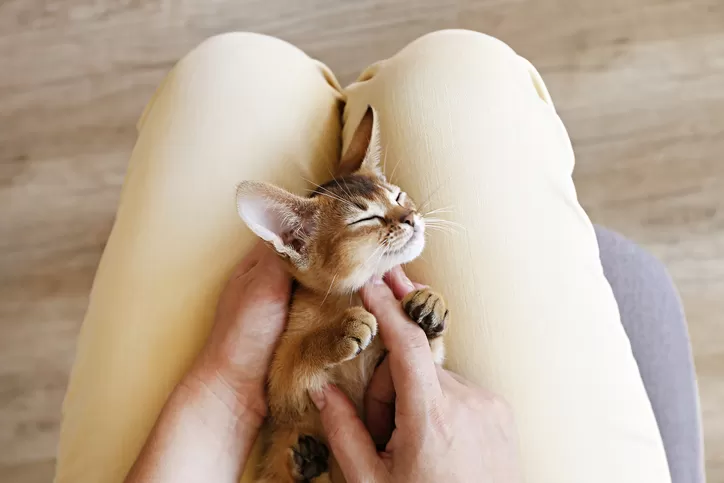 Orange kitten looking up while being gently scratched on the chin
A Gene’s Story of Domestication
To understand the bigger picture, the team didn’t stop at domestic cats. They examined the same gene in 11 other wild cat species, including the domestic cat’s closest relatives like the fishing cat and the leopard cat. What they discovered was remarkable: the long version of the androgen receptor gene was only present in domestic cats (Felis catus). It wasn’t found in any of their wild cousins.
This unique genetic difference strongly suggests that the long-type gene version likely emerged during the process of cat domestication. As wild cats gradually became accustomed to living alongside humans – a journey possibly originating in ancient Egypt – their genetic makeup began to subtly shift.
Purring: Communication, Survival, or Both?
Why would a gene related to vocalization change during domestication? The researchers propose an intriguing theory. They noted that pure-bred cats (often consistently raised in human environments) were more likely to have the long-type gene compared to mixed-breed cats (which might have started life as strays).
Their hypothesis is that cats who rely less on constant vocal communication for survival – perhaps because they are cared for by humans – might be more likely to possess the long-type gene version. In the wild, vocalization is crucial for communication, territory marking, and survival. But in a stable, human-provided home, the pressure to be constantly vocal might decrease, allowing variations like the long-type gene to become more common in certain populations.
“This result aligns with the association between purring and vocal communication as strategies for seeking attention or support, benefiting survival through interactions with both cats and humans,” the team explains in their published paper.
 Close up of a cream-colored cat with green eyes sitting on a scratching post indoors.
However, purring isn’t only linked to seeking attention or contentment. Cats are also known to purr when injured or in distress. This has led some scientists to suggest that the low-frequency vibrations (around 25 to 30 Hz) created during purring might have a physical benefit, potentially even acting as a healing mechanism by promoting bone density or tissue repair.
Adding another layer to the mystery, previous research has shown how cats physically produce the purr: not through muscle contractions, but via squishy pads within their vocal cords that vibrate as air passes over them. This suggests the purr mechanism is somewhat automated.
The Future of Feline Understanding
While this new study doesn’t definitively solve the entire purr puzzle, identifying a genetic link is a significant step forward. It provides a concrete biological basis to investigate further, offering a potential pathway to understand how this unique vocalization evolved and its different roles in a cat’s life.
As lead researcher Yume Okamoto says, “Through our research, we hope to deepen our understanding of cats and contribute to building happier relationships between cats and humans.” By unraveling the genetic instructions behind the purr, we move closer to truly understanding the language and history of our beloved feline companions.
This fascinating research was published in the journal PLOS One.





