
Exploring our solar system is more than just mapping planets and moons; it’s a journey back in time to understand how we all came to be. NASA’s planetary science missions delve into the origins and evolution of worlds, driven by the fundamental questions of our place in the cosmos and the potential for life beyond Earth. By studying other planets and small bodies, we uncover the secrets of our solar system’s past and look towards its future, including protecting our own planet.
Contents
Key takeaways:
- NASA’s planetary science seeks to understand the solar system’s formation and evolution.
- Missions explore diverse worlds, from icy moons with hidden oceans to metal asteroids.
- The search for past or present signs of life is a core driver.
- Data from these missions informs our understanding of exoplanets and planetary defense.
- Future exploration is guided by scientific roadmaps developed by the research community.
Why Explore Other Worlds? A Cosmic History Book
Think of our solar system as a vast, ancient library, with each planet, moon, and asteroid holding chapters of its history. NASA’s planetary science is like reading this cosmic history book page by page. Through robotic spacecraft, sophisticated instruments, and careful observations, we peel back layers of rock, ice, and atmosphere to understand the building blocks of our solar system and the dramatic processes that shaped them over billions of years.
This quest for knowledge isn’t just about the past. Understanding our solar system’s formation helps us interpret observations of planets orbiting distant stars (exoplanets) studied in NASA’s astrophysics research. Furthermore, tracking the paths of asteroids and comets is vital for planetary defense, ensuring we’re prepared if one ever poses a threat to Earth. (Rest assured, none are currently causing concern).
The direction of NASA’s planetary exploration is largely shaped by the scientific community through comprehensive reports, like the “Decadal Survey” published every ten years by the National Academies of Sciences, Engineering, and Medicine. The current survey, “Origins, Worlds, and Life: Planetary Science and Astrobiology in the Next Decade, 2023-2032,” provides a roadmap for key science questions and how NASA missions can help answer them.
Missions Exploring the Cosmos
NASA’s Planetary Science Division manages a wide array of missions visiting diverse destinations across the solar system. Here are some highlights:
Hunting for Ocean Worlds: Europa Clipper
One of the most exciting frontiers in the search for life is Jupiter’s moon Europa. Evidence suggests a vast, salty ocean hides beneath its icy crust – a place where life could potentially exist. NASA’s Europa Clipper is the first mission dedicated to a detailed scientific investigation of this intriguing moon, specifically searching for signs of habitability. The mission launched in October 2024. You can read more about Europa Clipper here.
Visiting a Metal World: Psyche
Deep in the main asteroid belt between Mars and Jupiter lies a unique object: the asteroid Psyche. Unlike rocky or icy asteroids, Psyche appears to be primarily made of metal. Scientists believe it might be the partial core of a planetesimal, a building block of a planet, that was stripped of its outer layers. The NASA Psyche spacecraft, launched in October 2023, is traveling to this fascinating target to study its composition and understand what it can tell us about how rocky planets form. Learn more about the Psyche mission.
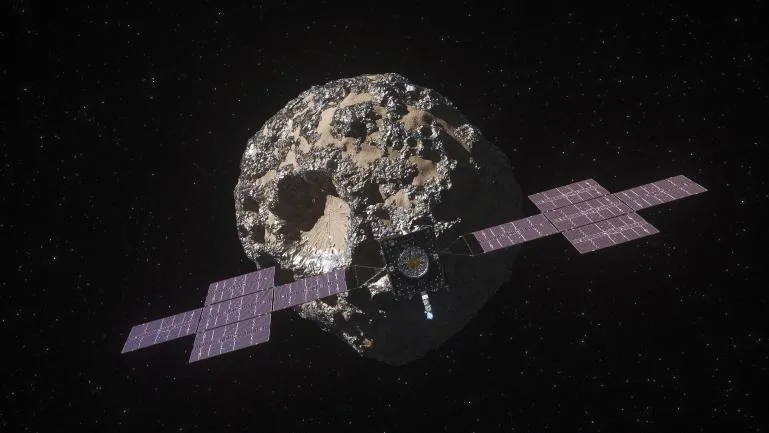 Artist's illustration depicts the NASA Psyche spacecraft orbiting the unique, metal-rich asteroid Psyche in the main asteroid belt.
Following Ancient Footsteps: Lucy
NASA’s Lucy mission is on a unique journey to the Trojan asteroids, two large groups of asteroids that share Jupiter’s orbit, leading and trailing the giant planet. These asteroids are thought to be primordial material, leftover building blocks from the solar system’s formation. Lucy, launched in October 2021, will perform multiple flybys of these distant objects. Along the way, it has already made extraordinary close encounters with asteroids in the main belt, including Dinkinesh and Donaldjohanson.
Searching for Life on Mars: Perseverance Rover
Mars has long captivated our imagination as a potential home for life, past or present. NASA’s Perseverance rover is meticulously exploring Jezero Crater, an ancient lakebed, to study the geology and search for signs of microbial life that might have existed billions of years ago when Mars was wetter and warmer. Perseverance is also collecting samples of Martian rock and soil, which future missions could potentially return to Earth for detailed analysis. This mission also included the groundbreaking Ingenuity helicopter, the first aircraft to achieve powered, controlled flight on another planet. Perseverance launched in July 2020. Explore the Mars 2020 Perseverance mission details.
What’s Next?
NASA’s planetary science portfolio continues to grow, pushing the boundaries of our understanding. Each mission provides new clues in the grand story of the solar system’s creation, the evolution of its diverse worlds, and the enduring question of whether life exists beyond Earth. The insights gained from these robotic explorers pave the way for future investigations, potentially including human exploration, and deepen our appreciation for our cosmic neighborhood.
Curious to learn more? Dive deeper into the search for life with NASA’s astrobiology research or explore the full scope of NASA’s planetary science division.





