Imagine watching milk swirl into your coffee – a everyday example of turbulence. Now, imagine that swirling on a cosmic scale, within the vast space between stars. For the first time, scientists have created a supercomputer simulation offering an incredibly detailed look at this interstellar turbulence and how it interacts with magnetic fields, revealing dynamic forces that shape galaxies.
Contents
This groundbreaking work provides a window into the chaotic yet fundamental processes governing the universe, helping us understand everything from star formation to the behavior of solar wind.
What is Turbulence in Space?
On Earth, turbulence is the choppy flow you see in rivers or feel on an airplane ride. In space, it’s the swirling, chaotic motion of gas and charged particles (plasma) that exist between stars – the interstellar medium. This cosmic “soup” is incredibly diffuse, far thinner than any vacuum we can create on Earth. Yet, its turbulent movement is powerful enough to influence structures across light-years.
Intertwined with this turbulent plasma are magnetic fields. Unlike the strong magnet on your fridge, these cosmic fields are millions of times weaker. But in the near-vacuum of space, they play a crucial role, guiding the flow of charged particles and impacting how cosmic clouds collapse to form stars.
A New Window into Cosmic Swirls
Previously, simulating this complex interplay of turbulence and magnetic fields was challenging. Scientists needed a way to model the phenomenon at different scales simultaneously, from localized streams like the solar wind to the vast magnetic structure of an entire galaxy.
A new supercomputer model, described in Nature Astronomy, changes this. Led by astrophysicist James Beattie and colleagues, the research used the powerful SuperMUC-NG supercomputer to create a scalable simulation. Think of it like building with virtual LEGO bricks – these modules can be combined to simulate massive galactic magnetic fields or scaled down to study smaller, turbulent regions.
Crucially, this model is the first to realistically simulate the dynamic nature of these cosmic magnetic fields, showing how they shift, swirl, and interact with the charged particles as they move through space. This level of detail provides an unprecedented view of the complex dynamics at play in the interstellar medium.
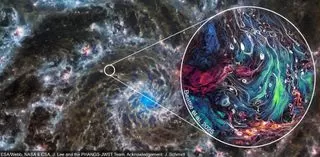 Colorful simulation reveals complex turbulence in the interstellar medium
Why Does This Matter? Understanding Our Cosmic Neighborhood
Understanding interstellar turbulence and its connection to magnetic fields is vital for unraveling some of the universe’s biggest mysteries. These forces are fundamental drivers in the cosmos.
They influence the birthplaces of stars, shaping how vast clouds of gas collapse under gravity. They also affect how energy and particles travel through space, impacting phenomena like the solar wind that flows from our own sun. By accurately simulating these processes, scientists can gain deeper insights into how galaxies like our Milky Way formed and evolved.
This work builds upon our growing understanding of cosmic phenomena, connecting perhaps surprisingly to fields beyond traditional physics, such as the turbulent patterns found in nature and even art, like the famous swirling sky in Van Gogh’s ‘The Starry Night’.
Looking Ahead
This detailed simulation is just the beginning. The research team plans to increase the resolution of their models further, aiming for even greater precision. They also intend to compare their simulation results with real-world astronomical data.
Future observatories, such as the Square Kilometre Array currently under construction in Australia and South Africa, will provide incredibly sensitive measurements of cosmic magnetic fields and plasma, offering valuable data to test and refine these powerful new simulations. As our computing power grows and our observational capabilities improve, we’re getting closer than ever to truly understanding the invisible, turbulent forces shaping the universe around us.