Imagine a machine that, for a fleeting moment, generates more power than all the world’s electrical grids combined. That’s the kind of incredible energy now being channeled by the new most powerful laser in the United States. Located at the University of Michigan, this Zettawatt-Equivalent Ultrashort pulse laser System, known as ZEUS, has successfully fired its first official experiment pulse at a staggering 2 petawatts (that’s 2 quadrillion watts), roughly doubling the peak power of any other laser in the U.S.
Contents
This groundbreaking achievement isn’t just about breaking records; it’s about unlocking unprecedented scientific capabilities. The ZEUS laser’s immense power, concentrated into pulses lasting mere quintillionths of a second, allows scientists to explore extreme conditions rarely found outside of distant stars or black holes. This opens doors to potential advancements in areas from medicine to national security and fundamental physics.
Reaching Extreme Power: The ZEUS Milestone
The ZEUS facility marks a significant leap forward for high-intensity laser science in America. Achieving the 2-petawatt mark is the result of dedicated effort by researchers at the University of Michigan’s Gérard Mourou Center for Ultrafast Optical Science.
Think of power like water flowing through a pipe. Petawatts represent an incredibly intense flow, but for ZEUS, that flow happens for an almost unbelievably short time – just 25 quintillionths of a second. This brief, powerful burst of energy is key to the unique experiments conducted here.
“This milestone marks the beginning of experiments that move into unexplored territory for American high field science,” stated Karl Krushelnick, director of the center housing ZEUS.
What Can Such Extreme Light Do?
The power of the ZEUS laser isn’t just for show. It’s designed as a tool to push the boundaries of physics and explore phenomena that are difficult or impossible to study otherwise.
Researchers plan to use ZEUS to delve into areas like plasma science and quantum physics under extreme conditions. But the implications reach far beyond fundamental research. Scientists anticipate applications that could impact our everyday lives:
- Medical Advancements: Potentially leading to better imaging techniques for soft tissues and improving technology used in cancer treatment.
- Materials Science: Studying how materials behave under incredibly intense energy conditions.
- Astrophysics: Simulating conditions found in space, like those around black holes or in cosmic rays, to better understand the universe.
- National Security: Exploring new possibilities related to high-energy physics.
A National Hub for High-Intensity Science
Funded by the U.S. National Science Foundation (NSF), ZEUS operates as a user facility. This means research teams from universities and institutions across the U.S. and internationally can propose experiments to use this unique capability.
This collaborative approach is crucial for maximizing the scientific output of ZEUS. As Franklin Dollar, a professor from the University of California, Irvine, whose team ran the first user experiment at 2 petawatts, noted, “One of the great things about ZEUS is it’s not just one big hammer, but you can split the light into multiple beams.” He added that having this national resource is vital for bringing high-intensity laser science back to the forefront in the U.S.
Research scientist Yong Ma works on the powerful ZEUS laser system at the University of Michigan.
Since opening in October 2023, ZEUS has already hosted numerous experiments, welcoming dozens of researchers from institutions globally.
Looking Ahead: The Path to a Zettawatt Equivalent
While reaching 2 petawatts is a significant milestone, the ZEUS team isn’t stopping there. Their ultimate goal involves leveraging this power to create a truly unique scientific environment.
Later this year, a signature experiment is planned where accelerated electrons will collide with the laser pulses coming from the opposite direction. The physics of relativity means that from the perspective of the fast-moving electrons, the 3-petawatt laser pulse they encounter will appear dramatically more powerful – equivalent to a zettawatt-scale pulse (that’s a sextillion watts!). This incredible trick of physics is what gives ZEUS its name: the “Zettawatt Equivalent Ultrashort laser pulse System.”
Detailed view of intricate optical components within the ZEUS powerful laser facility.
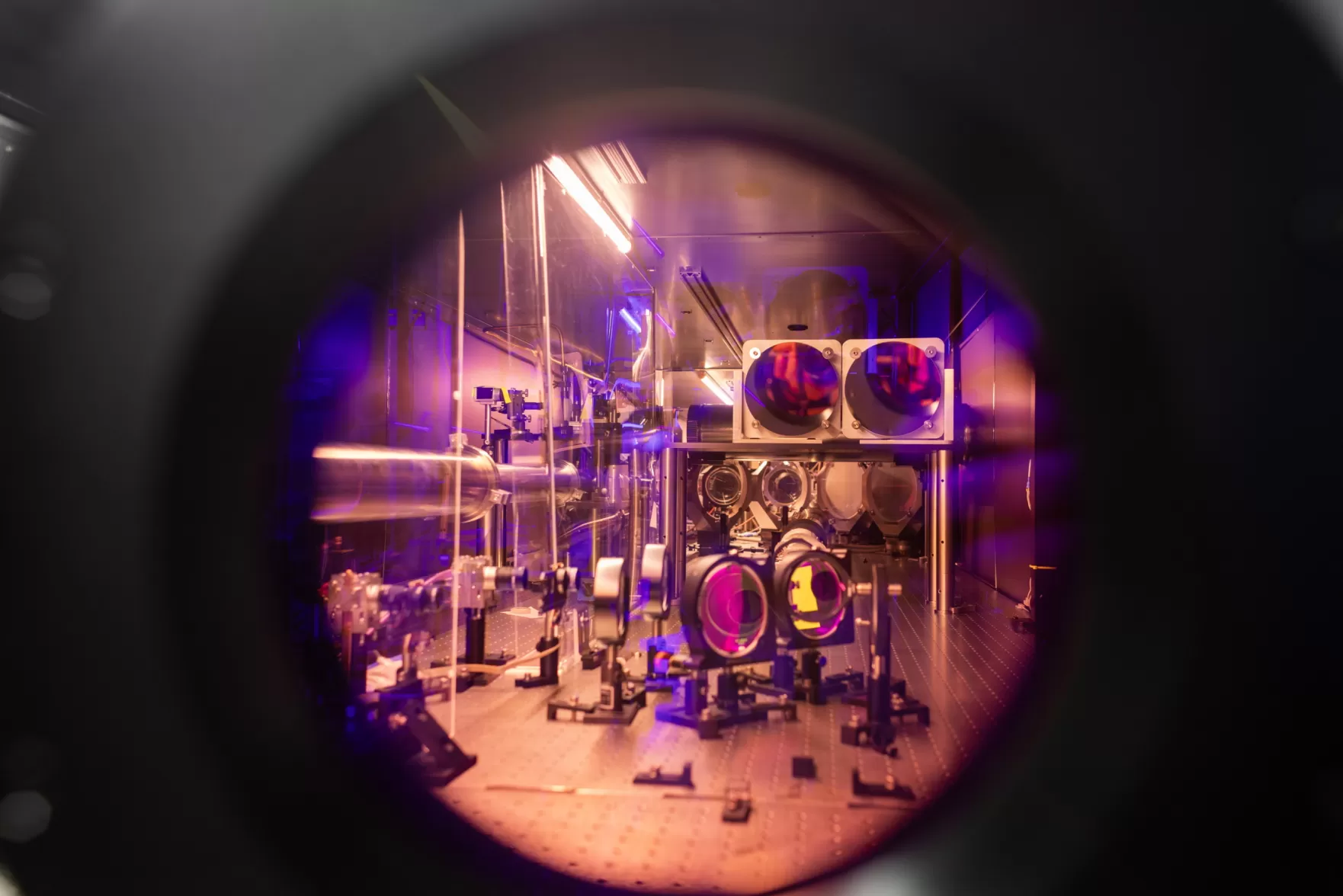 Detailed view of intricate optical components within the ZEUS powerful laser facility.
As Vyacheslav Lukin, program director at the NSF Division of Physics, highlighted, “Scientists using the unique capabilities of ZEUS will expand the frontiers of human knowledge in new ways and provide new opportunities for American innovation and economic growth.”
The team continues to upgrade the system towards its full power capability between user experiments, promising even more exciting discoveries on the horizon. The activation of the US’s most powerful laser is just the beginning of exploring a new realm of high-energy physics, potentially leading to breakthroughs that could shape our future.