
One of the universe’s greatest mysteries is dark matter – the invisible “stuff” that makes up about 85% of all matter. Scientists don’t know what it is, but a new study shows how NASA’s upcoming Nancy Grace Roman Space Telescope could help uncover its secrets using a cosmic trick predicted by Einstein: gravitational lensing. The telescope is expected to find thousands of these warped cosmic views, offering unprecedented clues about dark matter’s nature.
Contents
Here’s what you need to know:
- Dark matter is invisible and doesn’t interact with light, making it hard to study directly.
- According to Einstein, massive objects bend space-time, warping the path of light passing by – an effect called gravitational lensing.
- The Roman telescope’s wide, sharp vision will find thousands of gravitational lenses.
- By studying how dark matter warps space through these lenses, scientists can learn about its distribution and potentially what particles it’s made of.
Unpacking the Dark Matter Puzzle
Imagine trying to understand something you can’t see, touch, or interact with directly, yet it’s everywhere and shapes the cosmos. That’s the challenge of dark matter. We know it exists because of its gravitational pull on visible matter, like stars and galaxies. Without it, galaxies wouldn’t spin the way they do, and structures in the universe wouldn’t have formed as they did.
But unlike the atoms that make up everything we can see – planets, stars, even you and me – dark matter doesn’t interact with light or other forms of electromagnetic radiation. This invisibility means it can’t be made of protons, neutrons, and electrons like normal matter. Scientists are hunting for entirely new particles that could be dark matter, venturing beyond the standard model of particle physics.
So, how do you study something invisible? You look at its effects on things you can see, particularly its effect on gravity.
How Gravity Acts Like a Cosmic Lens
According to Albert Einstein’s theory of general relativity, massive objects warp the fabric of space-time around them. Think of placing a heavy ball on a stretched rubber sheet – it creates a dip. Light traveling near this dip follows the curve, just like a marble rolling near the ball. This bending of light by gravity is called gravitational lensing.
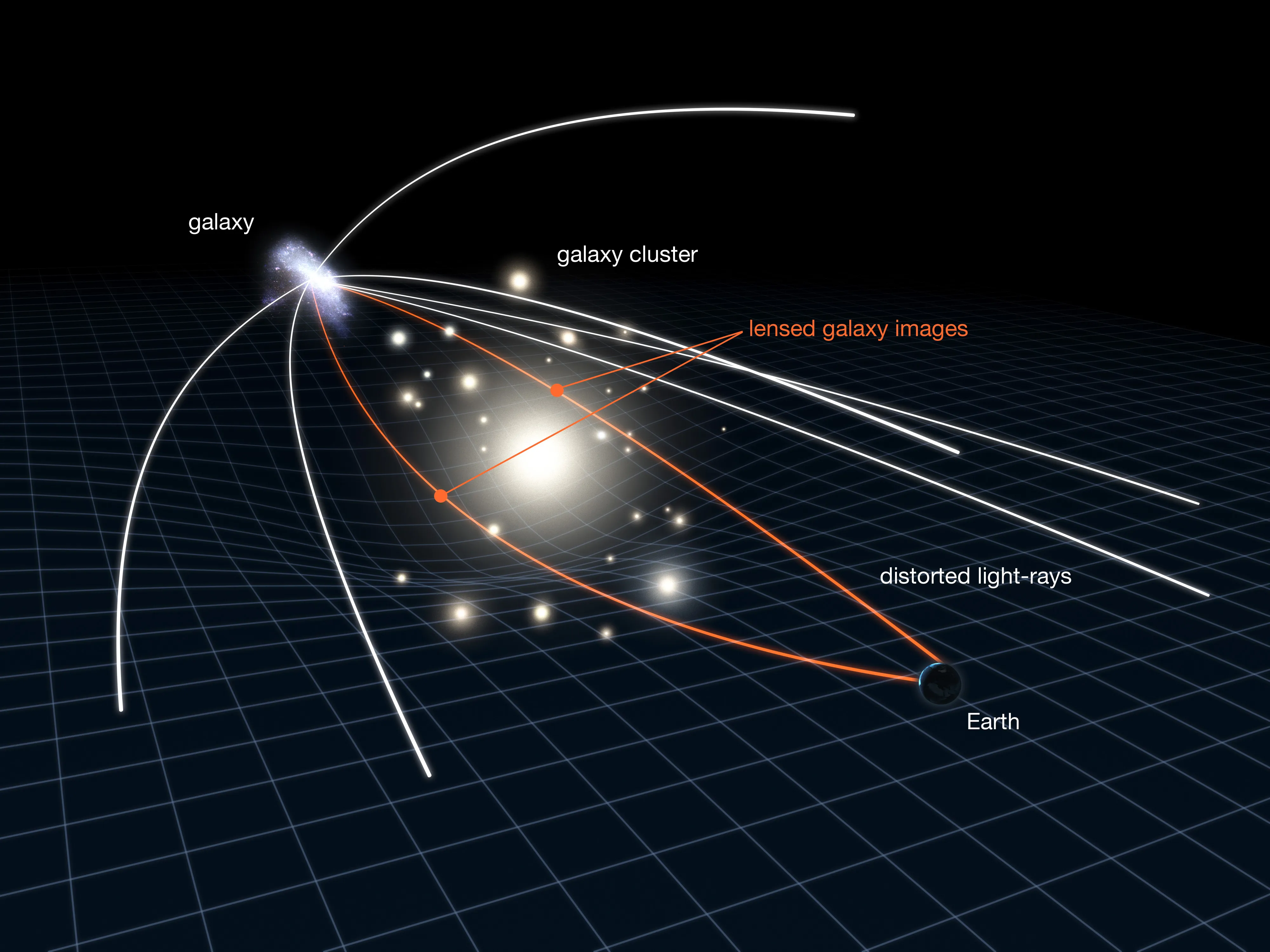 Diagram illustrating how light from a distant galaxy is bent and magnified as it passes a massive object like a galaxy, causing gravitational lensing
When light from a distant galaxy passes a massive object like another galaxy on its way to us, its path gets bent. This can distort the background galaxy’s image, make it appear brighter, or even create multiple images of the same galaxy spread around the lensing object. Famous examples include Einstein rings and crosses.
The crucial part for dark matter hunters is that the way the light is bent depends on how the total mass (both normal and dark matter) is distributed within the lensing object. By carefully measuring the positions and distortions of the lensed images, scientists can map out the invisible dark matter’s gravitational footprint.
Roman: A New Giant Eye on the Sky
Enter the Nancy Grace Roman Space Telescope, scheduled for launch in 2027. While telescopes like the Hubble Space Telescope have provided stunning, detailed views of small patches of the sky, Roman is designed for vast cosmic surveys. Its primary instrument, the Wide Field Instrument, can capture images around 200 times larger than Hubble’s at similar resolution.
This huge field of view is key to finding gravitational lenses. While lensing is common, finding ideal cases for studying dark matter requires specific alignments and bright background sources. By scanning vast areas of the sky quickly, Roman is expected to discover a treasure trove of these cosmic magnifying glasses.
A new study, published in The Astrophysical Journal, predicts that Roman’s surveys could reveal about 160,000 gravitational lenses. Out of these, researchers estimate around 500 will be particularly well-suited for detailed studies of dark matter distribution within the lensing galaxies.
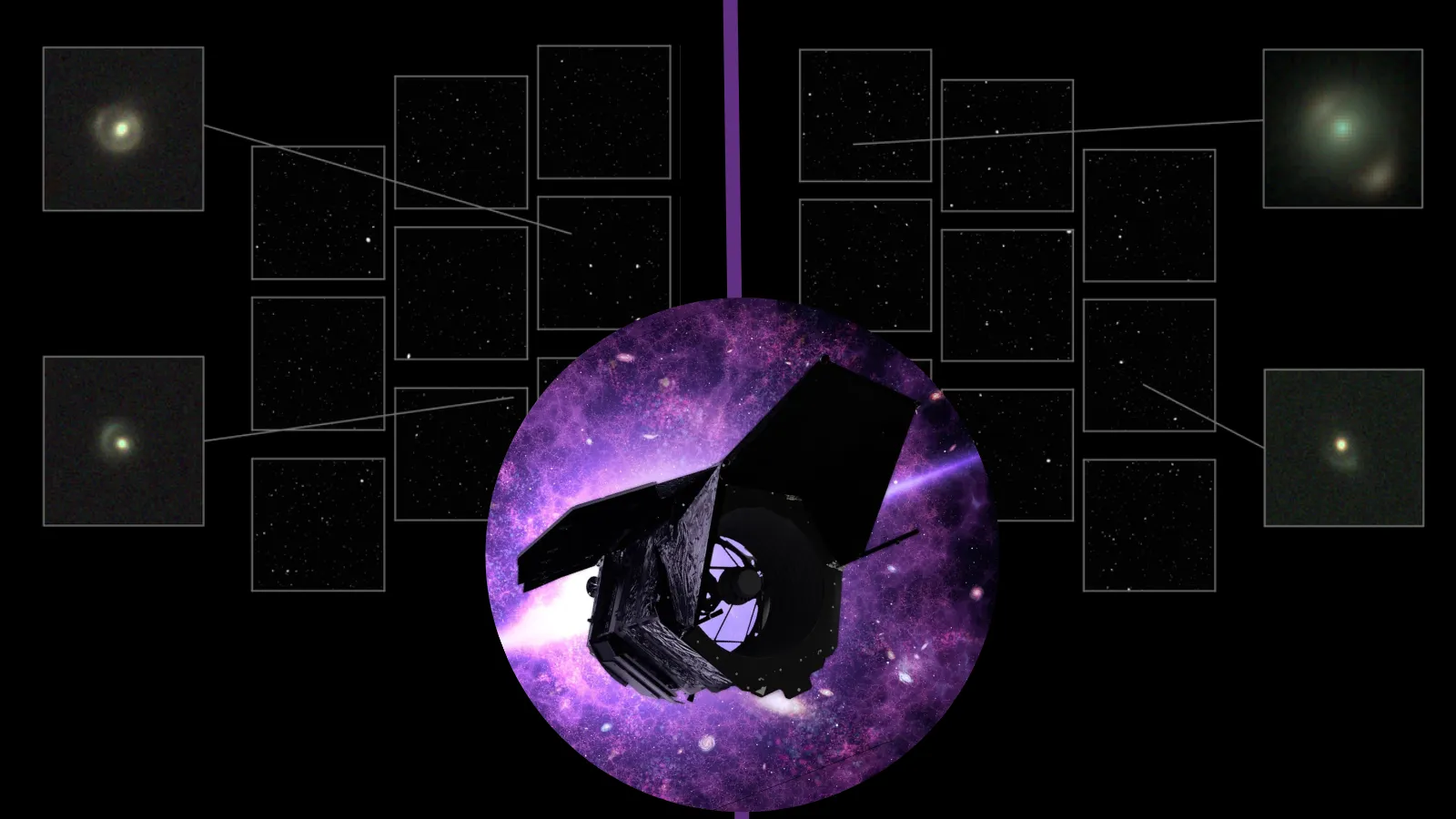 Illustration of the Nancy Grace Roman Space Telescope in space, showing its wide field of view observing distant galaxies and stars
“Ultimately, the question we’re trying to address is: What particle or particles constitute dark matter?” said Tansu Daylan, a faculty fellow at Washington University in St. Louis and principal investigator of the research team. “While some properties of dark matter are known, we essentially have no idea what makes up dark matter. Roman will help us to distinguish how dark matter is distributed on small scales and, hence, its particle nature.”
The sharp images from Roman’s 300-megapixel camera will allow scientists to measure the subtle bending of light with incredible precision – like measuring the width of a human hair from over two football fields away. This sensitivity means Roman can detect the gravitational effects of smaller, less massive clumps of dark matter.
These smaller clumps are particularly interesting because they might offer clues about how the universe’s structure, including galaxies, began to form in the early cosmos. Studying them through gravitational lensing could help distinguish between different theories about what dark matter is made of.
Bryce Wedig, also of Washington University in St. Louis and a leader of the study team, explained the strategy: “Finding gravitational lenses and being able to detect clumps of dark matter in them is a game of tiny odds. With Roman, we can cast a wide net and expect to get lucky often.”
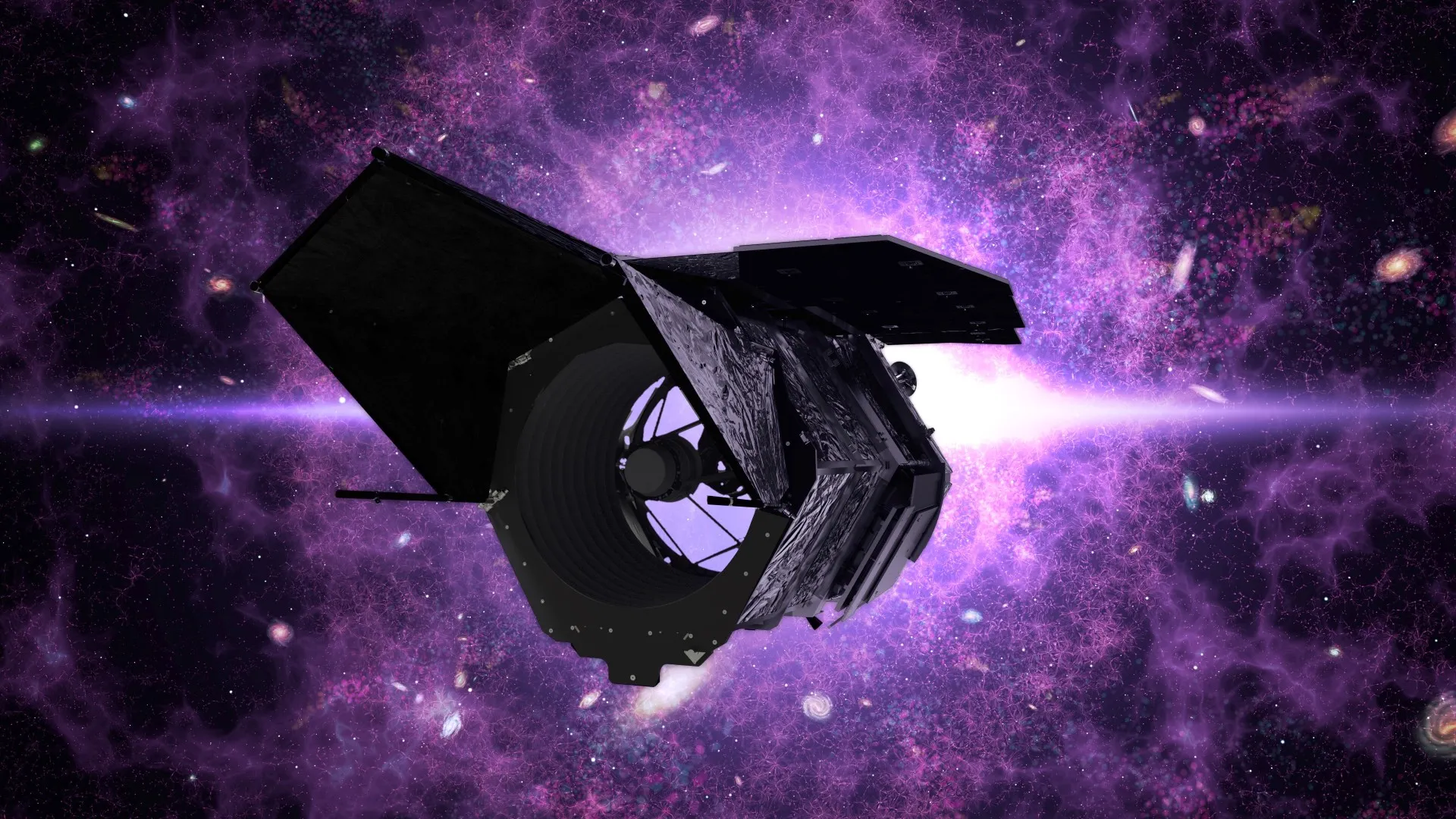 Artist's concept showing the Nancy Grace Roman Space Telescope in deep space with its main mirror visible
Wedig emphasized, “We won’t see dark matter in the images — it’s invisible — but we can measure its effects.”
By analyzing the collection of lenses Roman discovers, scientists aim to build a clearer picture of how dark matter is spread throughout the universe, from the vast scales of galaxy clusters down to smaller, galaxy-sized clumps. This detailed mapping could finally help pinpoint the elusive particle nature of dark matter.
“We will push the limits of what we can observe,” Daylan concluded, “and use every gravitational lens we detect with Roman to pin down the particle nature of dark matter.”
The research highlights Roman’s potential to transform our understanding of dark matter, opening a new window into one of science’s most enduring mysteries.
Curious to learn more about the universe’s hidden components? Check out related stories on the Milky Way’s dark matter halo or how future particle colliders might hunt for the dark universe.





