
For decades, we’ve pictured the universe beginning with a sudden, explosive moment – the Big Bang. But what if that wasn’t the absolute start? A new study proposes a fascinating alternative: what if our universe didn’t begin from an infinitely dense point, but instead emerged from a “bounce” deep inside a massive black hole formed in another, larger universe? This black hole universe concept, grounded in known physics, offers a potential answer to some of cosmology’s biggest mysteries and has testable predictions that future missions could verify.
Contents
The Big Questions Left by the Big Bang
The standard model of cosmology, built on the Big Bang and the idea of rapid early expansion called cosmic inflation, has been incredibly successful at describing how the universe looks today. However, it faces some fundamental challenges.
One major puzzle is the singularity at the very beginning of the Big Bang. This is a point of infinite density where the laws of physics as we understand them break down completely. It’s like hitting a wall in our understanding – we can’t truly describe what happened at that point.
To make the standard model work and explain features like the universe’s large-scale structure, scientists introduced concepts like cosmic inflation (an extremely rapid expansion phase) and dark energy (a mysterious force accelerating the universe’s current expansion). These ideas fit observations but rely on components we haven’t directly detected.
In essence, the standard model works, but it requires adding new, unseen ingredients to the cosmic recipe. The most basic questions remain: Where did it all come from? Why is the universe so uniform and vast?
 Conceptual diagram illustrating possible universe origins, potentially contrasting Big Bang and bounce scenarios.
Looking Inward: The Black Hole Bounce
A new paper published in Physical Review D by a team of researchers offers a different perspective. Instead of starting with an outward expansion and trying to trace back, they looked at what happens when matter collapses inward due to gravity.
We see this process with stars, which collapse under their own weight to form black holes. Black holes are regions of spacetime where gravity is so strong that nothing, not even light, can escape their event horizon. But what happens inside a black hole is still a profound mystery.
Classical physics, which describes the everyday world and large structures like stars, predicts that gravitational collapse leads to a singularity, similar to the one in the Big Bang model. This was famously shown by physicist Roger Penrose. However, classical physics doesn’t fully apply at the extreme densities found at the heart of collapse.
Quantum Pushback Prevents Collapse
This is where quantum mechanics comes in. Quantum mechanics governs the world of tiny particles, like atoms and electrons. One of its key rules is the Pauli exclusion principle, which states that certain identical particles (called fermions) cannot occupy the exact same quantum state. Think of it like trying to squeeze too many identical marbles into the same spot – eventually, they resist being packed any tighter.
The new model shows that when gravitational collapse reaches incredibly high densities, this quantum exclusion principle provides a “pushback.” It prevents the matter from collapsing all the way into a singularity. Instead, the collapse halts and reverses, leading to a bounce.
Crucially, this bounce happens entirely within the framework of general relativity (which handles gravity on cosmic scales) combined with basic quantum mechanics. It doesn’t require new, exotic fields or extra dimensions.
What Emerges After the Bounce?
What happens on the other side of this quantum bounce? According to the model, a universe remarkably like our own springs forth and begins expanding.
Surprisingly, the bounce naturally produces the two phases of accelerated expansion we observe: the early rapid expansion akin to inflation and the current accelerated expansion linked to dark energy. These aren’t driven by hypothetical fields but by the physics of the bounce itself.
Testable Ideas for the Future
One of the most exciting aspects of this black hole universe model is that it makes concrete, testable predictions.
It predicts that our universe should have a small, positive spatial curvature. This means space isn’t perfectly “flat” but slightly curved, like the surface of a giant sphere, though on scales far larger than anything we can easily perceive. This slight curvature would be a leftover signature from the initial conditions before the collapse and bounce.
Future observations, such as those from the European Space Agency’s ongoing Euclid mission, are designed to precisely measure the shape and expansion of the universe. If Euclid or other missions confirm a small positive curvature, it would strongly support the idea that our universe originated from such a bounce. The model also matches predictions for the current rate of the universe’s expansion.
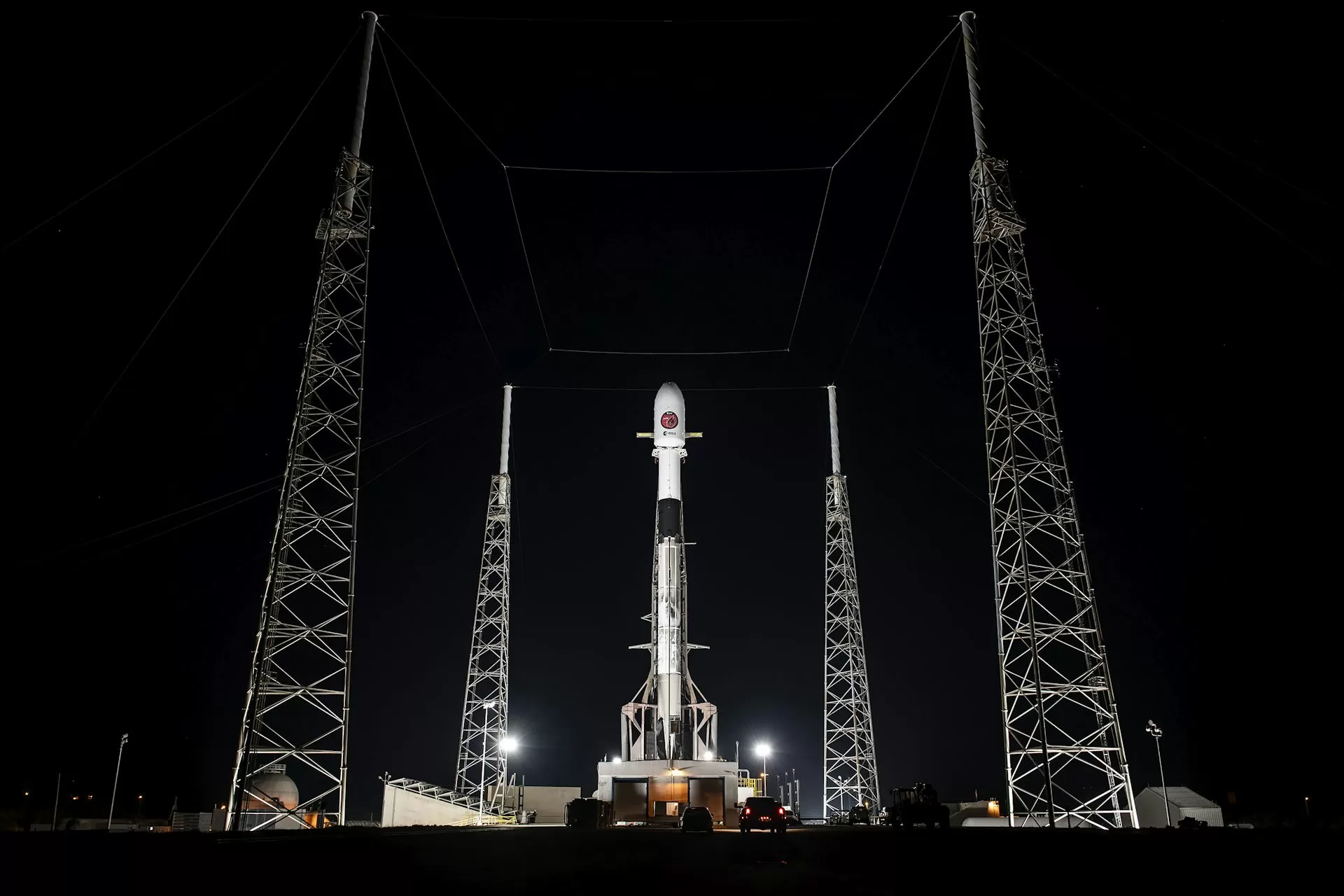 SpaceX Falcon 9 rocket launching ESA's Euclid mission spacecraft, designed to study the universe's expansion and structure.
Beyond the large-scale structure, this model could also shed light on other cosmic puzzles, such as the nature of dark matter and the formation of galaxies. It suggests that leftover objects, like mini black holes or dense clumps of dark matter, could have survived the bounce and influenced the formation of structures we see today. Missions like Arrakhis are being developed to study these smaller-scale structures and potentially find clues.
A New Cosmic Perspective
The black hole universe model offers a truly radical new way to think about our place in the cosmos. In this view, our entire observable universe exists within the interior of a black hole that formed from the collapse of matter in a larger “parent” universe.
It suggests we aren’t necessarily witnessing the absolute birth of everything from nothing, but rather participating in a continuous cycle driven by the fundamental forces of gravity and quantum mechanics. It’s a humbling perspective shift, perhaps as significant as realizing Earth wasn’t the center of the solar system.
While more research and observational evidence are needed, this idea provides a compelling, physics-based alternative to the standard Big Bang picture, offering new avenues for exploration and potentially solving some of the most profound mysteries of our universe’s origins.
To learn more about related cosmic concepts, explore articles on dark energy, cosmic inflation, or the shape of the universe.





