
Wild sulphur-crested cockatoos in Sydney, Australia, are displaying remarkable intelligence and adaptability by figuring out how to operate human water fountains. This complex behavior, involving turning twist handles with their feet and using their body weight, is spreading among local bird populations, forming a new “drinking tradition.” Scientists say this highlights how these clever birds are thriving by solving new problems in urban environments.
Contents
Key Takeaways:
- Sydney cockatoos use a complex sequence of actions to open twist-handle water fountains.
- This learned behavior is spreading locally, becoming a new tradition.
- The ability demonstrates their significant intelligence and adaptability to city life.
- The behavior may offer lessons in persistence and focus from the birds themselves.
How Cockatoos Master the Fountain
Imagine trying to get a drink from a tap designed for humans, but you only have feet and a beak. That’s essentially what some determined cockatoos are doing in Sydney parks. Researchers observed and videoed these birds approaching twist-handle water fountains and successfully manipulating them to get a drink.
Operating these specific fountains isn’t simple. It requires coordinating several steps: using both feet to grip the handle, turning it clockwise, and then applying body weight to keep the spring-loaded handle open long enough to drink from the spout. It’s a multi-step process that isn’t likely discovered by accident.
This impressive feat was documented in a study published in Biology Letters. Researchers analyzed videos showing the birds’ attempts, finding that around half of their efforts were successful.
A New Local “Tradition” Takes Hold
Scientists believe this ingenious behavior likely started with one particularly inquisitive bird that figured out the puzzle through trial and error. From there, the behavior spread as other cockatoos observed their peers.
According to study co-author Lucy Aplin, a cognitive ecologist at Australian National University, while the birds might learn the idea of using the fountain from others, they seem to perfect the technique individually. Videos show different birds have slightly varied “styles” of operating the handle.
This combination of social learning and individual refinement suggests the behavior is becoming well-established in the area, evolving into a local “drinking tradition” unique to these Sydney cockatoos.
Why Are Urban Animals So Clever?
Cities are rapidly changing environments, constantly throwing new challenges at the wildlife that lives in them. Animals that can adapt quickly and solve novel problems are more likely to thrive. This is especially true for birds with larger brains and a knack for innovation.
We see this in many urban species. Some city birds adjust their songs to be heard over traffic noise, while others use human structures like buildings for nesting. Cockatoos, in particular, are renowned for their intelligence. They’ve been observed using tools, solving complex puzzles, and in Sydney, famously figuring out how to open trash bins – earning them the nickname “trash parrots.” In fact, humans and cockatoos in Sydney are locked in something of an “innovation arms race” as people try to deter them from raiding bins and the birds find new ways around the obstacles.
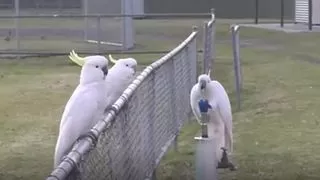 A still from a video of a cockatoo drinking from a water fountain at a park while two other cockatoos wait on a fence
The successful operation of the water fountain by a cockatoo demonstrates remarkable problem-solving skills.
Cognitive biologist Alice Auersperg notes that cockatoos possess a “playful curiosity” and are persistent when manipulating objects, especially if they get a reward like water. Berenika Mioduszewska, another animal cognition researcher, wasn’t surprised by the finding, stating that the birds’ high curiosity makes them likely to experiment with human objects like fountains if given the chance.
The Queue for a Drink
Intriguingly, the researchers also observed cockatoos queuing up, patiently waiting their turn to use the fountain. This social aspect suggests the resource is valuable to them.
It’s not entirely clear why they go to such lengths for fountain water when other sources might be available. Researchers hypothesize they might prefer the taste of the water or feel safer from predators in the open area around the fountain compared to more concealed water sources.
This research is part of a broader effort called the Clever Cockie Project, which investigates how the behavioral flexibility of intelligent birds like cockatoos helps them adapt to urban life.
As Mioduszewska points out, the cockatoos’ success offers a valuable lesson: persistence pays off. Longer, focused attempts were more likely to succeed, suggesting that minimizing distractions and keeping trying are key to mastering a new skill, whether you’re a bird or a human.
Want to learn more about fascinating bird behaviors? Check out these articles:
- Crows can count out loud, startling study reveals
- Do parrots actually understand what they’re saying?





