
The James Webb Space Telescope (JWST) has made history again, detecting light from a galaxy that existed just 280 million years after the Big Bang – making it the most distant galaxy ever observed. This incredible discovery opens a new window into the universe’s earliest moments, revealing unexpected details about how the first galaxies and stars began to form. Key takeaways include the galaxy’s surprising brightness, its star-dominated light, and a chemical makeup that remarkably resembles ancient star clusters found in our own Milky Way today.
Contents
A Cosmic Time Machine
Seeing the universe’s very first galaxies is crucial for understanding how cosmic structures formed and evolved over billions of years. Before JWST, observing these distant, ancient objects was incredibly difficult. Light from the early universe is stretched by the universe’s expansion, shifting it into infrared wavelengths.
Older telescopes like Hubble could only see a limited amount of near-infrared light and had smaller mirrors, like trying to peer through a tiny keyhole. Spitzer was built for infrared but had an even smaller mirror, like looking through a pinhole. JWST, with its much larger mirror and cutting-edge infrared detectors, acts like a powerful time machine, capable of capturing this faint, stretched-out light from the “cosmic dawn.”
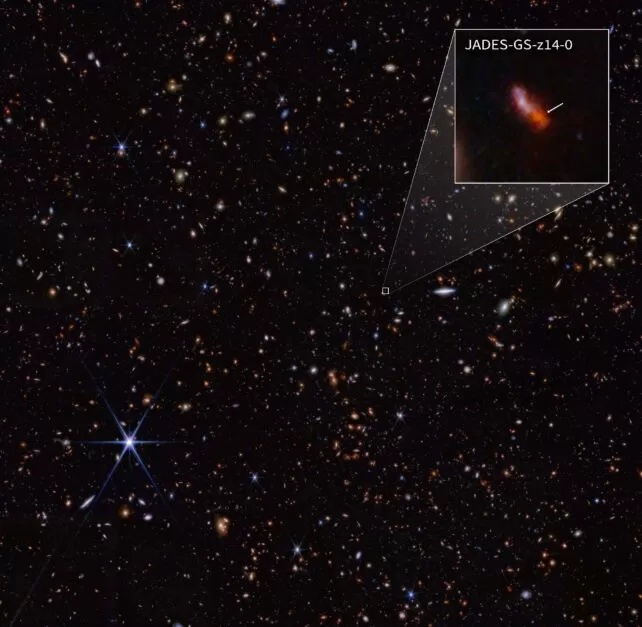 James Webb Space Telescope image showing distant early galaxies in the universe.
Within weeks of starting observations, JWST began finding unexpectedly bright galaxies from the universe’s first half-billion years, challenging existing theories about galaxy formation.
Introducing MoM-z14: The New Record Holder
The new record-breaking galaxy is named MoM-z14. It was found as part of the Mirage or Miracle survey, designed to confirm candidate galaxies that appear to be very distant. Its distance is measured by something called redshift, which indicates how much the light from an object has been stretched by the expansion of the universe. Think of it like the sound of a siren changing pitch as it moves away from you; the light shifts towards the red end of the spectrum the farther away and faster the object is receding.
At a redshift of 14.44, MoM-z14 shatters the previous record and shows JWST’s ability to push the boundaries of our observable universe even further back in time – to just 280 million years after the Big Bang. This finding was surprising because astronomers didn’t expect to find many galaxies so early and so bright.
The discovery is detailed in a new paper led by Rohan Naidu, highlighting the “remarkable luminosity” of this galaxy at such an early epoch.
Why This Galaxy is Special
MoM-z14 isn’t just a dot of light; its detailed spectral analysis provides clues about what was happening inside it.
Unlike some bright galaxies powered by active supermassive black holes at their centers, most of MoM-z14’s light comes from stars. This suggests it was a bustling factory of star formation in the early universe.
Even more fascinating is its chemical composition. MoM-z14 has a higher ratio of nitrogen to carbon than our Sun. This specific chemical fingerprint is similar to that found in some of the most ancient globular clusters orbiting our own Milky Way galaxy.
Clues from Shape and Chemistry
Astronomers have noticed that these bright early galaxies often appear in two basic shapes: very compact, like a single point of light, or slightly more spread out. Interestingly, the chemical makeup, particularly the nitrogen levels, seems linked to these shapes. Compact sources like MoM-z14 tend to be strong emitters of nitrogen, while more extended sources are weaker in nitrogen. This connection between a galaxy’s shape and its chemistry at such early times provides crucial insights into their different evolutionary paths. MoM-z14 could be among the most nitrogen-rich objects JWST has found so far, potentially falling into the category of luminous Little Red Dots.
 Graph showing the redshift and brightness of early galaxies discovered by the JWST, including the new record-holder.
Connecting the Dots: From Early Cosmos to Our Milky Way
This study provides a powerful connection between the distant past and the present universe. The chemical similarity between MoM-z14 and ancient globular clusters in the Milky Way suggests that the environments where stars formed in this earliest galaxy might have been similar to the conditions that gave birth to the oldest stars in our own galactic backyard billions of years later.
By studying these ancient galaxies with JWST, astronomers are using “galactic archaeology” to link the surprising finds from the cosmic dawn to the known structures and stellar populations in the modern universe, like globular clusters and the very first stars in the Milky Way (formed at redshifts around z ~ 4). The nitrogen enhancement and other properties of these early sources might be a signature of rapid star formation in dense, cluster-like environments, possibly even producing extraordinary objects like supermassive stars predicted by theory.
What’s Next in the Cosmic Quest?
While JWST continues to deliver groundbreaking results, pushing the frontiers of our knowledge, future telescopes promise even more insights. The upcoming Nancy Grace Roman Space Telescope, if realized, is expected to find hundreds more of these distant galaxies, providing a much larger sample to solidify current findings and potentially uncover entirely new mysteries.
For now, JWST holds the spotlight, showing that the era of the very first stars, previously thought to be out of reach, is now closer than ever to being observed directly. Each new distant galaxy detected brings us closer to understanding the universe’s first steps.





