
The James Webb Space Telescope (JWST) has just revealed an unprecedented look at the ancient cosmos: the largest map of the early universe ever created. This cosmic panorama, part of the COSMOS-Web project, covers a patch of sky the size of three full moons side-by-side and captures nearly 800,000 galaxies, many shining from the universe’s earliest epochs. It’s a landmark dataset offering scientists around the world a treasure trove of information about how galaxies formed and evolved billions of years ago.
Contents
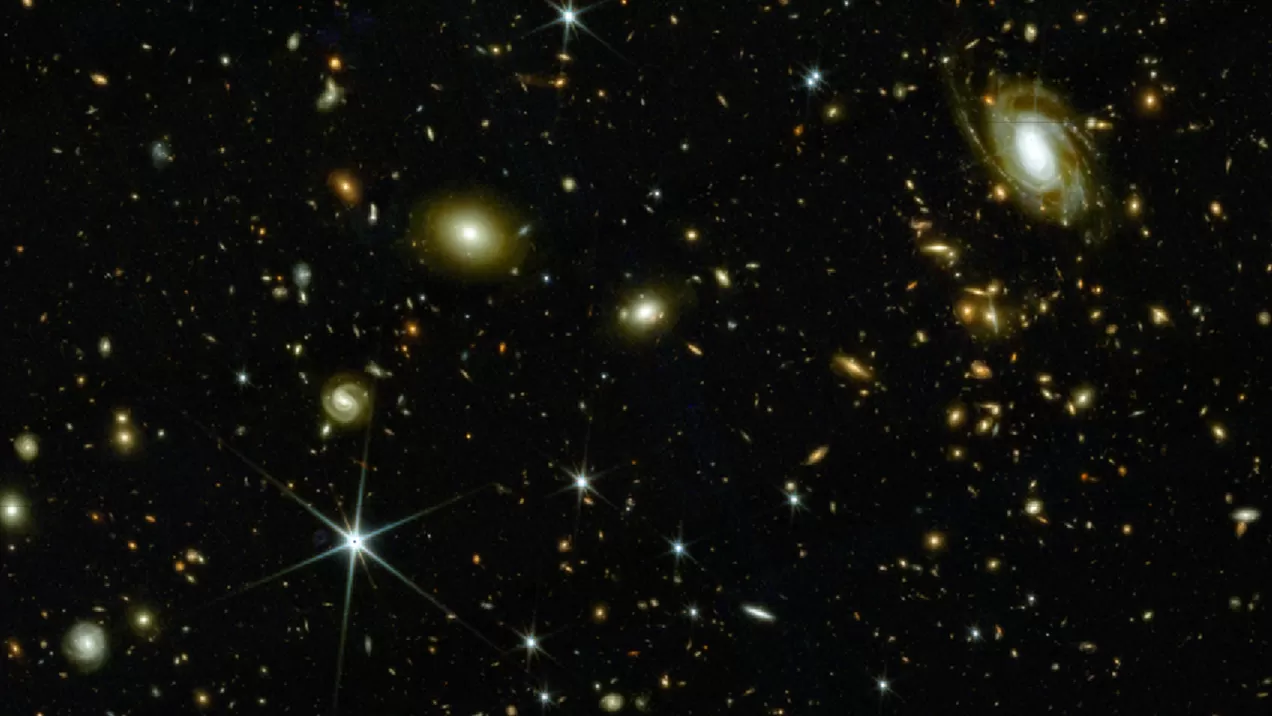 James Webb Space Telescope image from the COSMOS-Web survey showing a wide view of galaxies in the early universe.
What is the COSMOS-Web Project?
COSMOS-Web was the single largest observing program in the James Webb Space Telescope’s first year of operation, granted over 200 hours of precious telescope time. Unlike many JWST studies that zoom in deeply on tiny sections of the sky, COSMOS-Web prioritized covering a vast area. By stitching together more than 10,000 individual exposures, the team created a wide cosmic canvas that revealed far more than anticipated – finding 10 times more early galaxies than astronomers predicted would be visible in this region.
Maximilen Franco, a postdoctoral researcher involved in the project, shared the excitement: “It was incredible to reveal galaxies that were previously invisible at other wavelengths, and very gratifying to finally see them appear on our computers.”
A Window into Cosmic Evolution
This immense map isn’t just a pretty picture; it’s a detailed catalog providing information about each of the nearly 800,000 galaxies found. The team has released the largest contiguous image ever captured by JWST and a free, interactive catalog detailing the properties of these galaxies.
Jeyhan Kartaltepe, an astrophysicist and the lead researcher for COSMOS-Web, highlighted the lasting impact. “I don’t know if the James Webb Space Telescope will ever cover an area of this size again… I think it’ll be a good reference and a good data set that people will use for many years,” she said. The hope is that this data resource is now accessible to anyone who wants to use it for their own scientific investigations.
The sheer scale of the map allows astronomers to study galaxies not in isolation, but within their cosmic neighborhood. By observing how a galaxy’s characteristics like size, shape, and brightness are influenced by whether it’s alone or in a crowded region, scientists can learn a lot about the forces that shaped galaxies as they grew and changed over cosmic time.
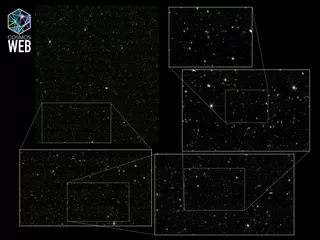 Montage from the JWST COSMOS-Web survey illustrating nine galaxies across different cosmic ages, revealing cosmic evolution.
Tracing the Universe’s First Light
One of the key goals for the COSMOS-Web project is to map the earliest large-scale structures that emerged during the Reionization Era. This period, over 13 billion years ago, was when the first stars and galaxies began to shine, clearing away the thick fog of neutral hydrogen gas that filled the early cosmos.
To study this, Kartaltepe and her team plan to use the locations of these early galaxies as beacons to measure the size of “reionization bubbles” – vast regions where light had successfully carved out clearings in the primordial haze. This research is still underway, but it’s a core part of the excitement surrounding the dataset.
Cutting-Edge Data Analysis
Creating this map was a massive undertaking, involving years of work processing and aligning over 10,000 individual images. As a brand-new telescope, the James Webb Space Telescope presented unique challenges, including unexpected patterns and distortions in the images that the team had to meticulously correct.
Researchers also developed new methods to maximize the science from this data. This included testing machine learning techniques to estimate galaxy properties more efficiently and creating a new approach to measure the brightness of distant galaxies more accurately than traditional methods allowed. These advances help combine JWST’s sharp views with data from other telescopes without losing crucial details.
 Screenshot of the interactive COSMOS-Web catalog interface, showcasing a dense field of distant galaxies observed by the JWST.
Beyond Expectations
Despite the complexities of working with a new observatory and such a vast amount of data, the JWST performed even better than expected, detecting fainter and more distant galaxies than pre-launch models predicted.
“The reality turned out to be better — we were able to go deeper than what we expected,” Kartaltepe noted. This success means the COSMOS-Web catalog holds “incredible potential” for discoveries.
The release of this map and catalog opens the door to countless new research possibilities, offering the world’s astronomers an unparalleled view into the universe’s ancient past and paving the way for future insights into cosmic history.
 A deep field view captured by the James Webb Space Telescope as part of the COSMOS-Web project, showing numerous galaxies in the distant universe.
Explore the interactive COSMOS-Web catalog yourself to see the distant universe up close.





