Imagine capturing the entire night sky every few nights, not just as a static picture, but as a detailed time-lapse movie showing how everything changes. That’s the incredible power of the Vera C. Rubin Observatory, home to the world’s largest digital camera. The recent release of its first breathtaking images signals the official start of a monumental 10-year project that promises to revolutionize our understanding of the universe, from fleeting cosmic explosions to the mysteries of dark matter and dark energy. This unprecedented survey will map billions of celestial objects, revealing hidden secrets and paving the way for groundbreaking discoveries.
Contents
For decades, astronomers have peered through telescopes, capturing snapshots of the distant cosmos. But the universe is a dynamic place, constantly shifting and changing. Stars explode, galaxies collide, and mysterious phenomena flicker into existence. To truly understand these changes, you need to watch the sky continuously and with incredible detail.
That’s the core mission of the Vera C. Rubin Observatory. Located high on Cerro Pachón in Chile, its massive 8.4-meter Simonyi Survey Telescope is equipped with a camera unlike any other. It’s essentially a 3.2-gigapixel digital eye, capable of capturing incredibly wide views of the night sky with stunning clarity. This allows it to undertake the Legacy Survey of Space and Time (LSST) – a decade-long project to build the most comprehensive, multi-dimensional map of the universe ever created.
The sheer sensitivity of Rubin is astounding. Each night, it will detect roughly 10,000 new objects in the sky. Scientists predict that within just its first year of operation, it will discover more asteroids in our own solar system than all previous telescopes combined. The observatory is named in honor of astronomer Vera C. Rubin, whose pioneering work provided some of the first strong evidence for the existence of dark matter, the unseen substance that makes up most of the universe’s mass.
 Vera C. Rubin Observatory sits atop a mountain under a cloudy sky.The Vera C. Rubin Observatory facility perched on Cerro Pachón in northern Chile, ready to survey the southern sky.
Canada’s Crucial Role in Unlocking the Data
The Rubin Observatory is a major collaboration primarily between the U.S. and Chile, but partner nations like Canada contribute vital resources, including computing power and personnel, in exchange for access to the treasure trove of data it produces.
For Canadian researchers and students, this means a direct pipeline to the most detailed cosmic data ever collected. Canada has invested in building the infrastructure needed to access, store, and analyze this massive dataset. This includes a data archive facility from the National Research Council and contributions from institutions like the University of Waterloo and the University of Toronto’s Dunlap Institute for Astronomy & Astrophysics, which helped secure funding for the Canadian Data-Intensive Astrophysics PLatform (CanDIAPL). This national platform is essential for processing and making sense of the firehose of data from Rubin.
Researchers across Canada, including many at the University of Toronto, have been eagerly anticipating this moment for years, developing the tools and techniques needed to tackle the vast dataset.
What Will Scientists Discover with Rubin?
With the LSST survey underway, Canadian astronomers are poised to make significant contributions to our understanding of the universe. Their work spans a wide range of cosmic phenomena:
-
Watching the Dynamic Sky: Some researchers, like Professor Maria Drout, are using Rubin’s ability to rapidly scan the sky to spot and study “cosmic transients” – events that change or appear suddenly, like stellar explosions and supernovae. These events are crucial for understanding the life cycles of stars and the chemical enrichment of the universe.
-
Hunting for Dark Energy: Professor Renée Hložek will leverage Rubin’s massive sample of supernovae, which act as cosmic distance markers, to study dark energy. This mysterious force is thought to be causing the universe’s accelerated expansion, and Rubin’s data will provide unprecedented insights into its nature and evolution over billions of years.
-
Mapping Our Galactic Neighborhood: Professor Gwendolyn Eadie and collaborators will use Rubin to find rare “RR Lyrae” stars far out in the Milky Way’s stellar halo. By studying these unique stars, they can map the shape and density of our galaxy’s faint outer edges, helping us understand its overall structure and mass distribution, including the distribution of dark matter within our galaxy.
-
Exploring Dwarf Galaxies and Galactic History: Professor Ting Li will use the deep images from Rubin to search for faint dwarf galaxies and streams of stars ripped from smaller galaxies orbiting the Milky Way. Studying these relics helps piece together the merger history of our own galaxy and understand how smaller galaxies form and evolve.
-
Understanding Galaxy Evolution and Cosmic Mysteries: Professors Bob Abraham and Josh Speagle will use Rubin’s images to investigate how galaxies grow and change over cosmic time. Building on their experience with other major surveys like DESI, they will use Rubin data to shed more light on the fundamental nature of dark matter and dark energy.
-
Applying Artificial Intelligence: The sheer scale of Rubin data requires new methods for analysis. Researchers like Professor Josh Speagle, Mike Walmsley, and Biprateep Dey are applying cutting-edge AI techniques to identify and classify billions of stars and galaxies automatically, accelerating the pace of discovery.
-
Inviting Citizen Scientists: The Rubin project isn’t just for professional astronomers. Mike Walmsley is involved in sharing Rubin images on platforms like Zooniverse’s Galaxy Zoo, where volunteers can participate in classifying galaxies, contributing directly to research and helping train AI models. This is a fantastic opportunity for anyone to become a citizen scientist and explore the universe.
-
Training the Next Generation: Professor Michael Reid is integrating Rubin resources into undergraduate astronomy courses. This gives students direct access to cutting-edge data and the chance to participate in real research, even using university telescopes to follow up on interesting transient events spotted by Rubin.
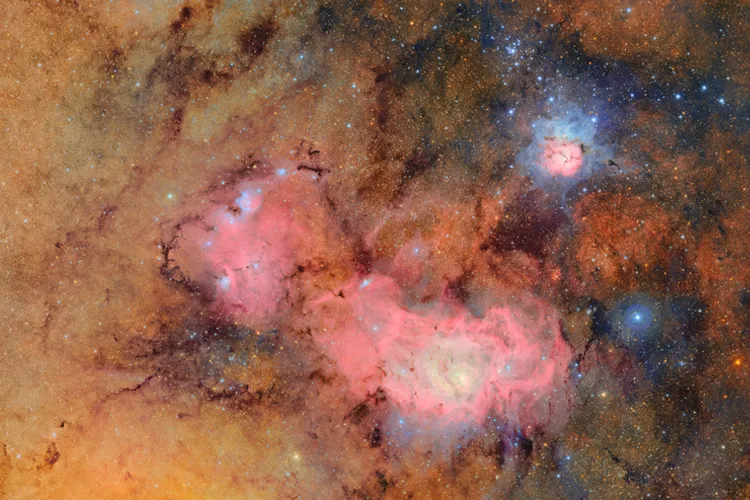 Colorful clouds of interstellar gas and dust fill the image.An early Rubin Observatory image showcases intricate structures of gas and dust clouds within our galaxy, thousands of light-years away.
A New Window on the Cosmos
The release of the first images from the Vera C. Rubin Observatory and the commencement of the LSST survey mark the beginning of an exciting new chapter in astronomy. By creating an unprecedented time-lapse view of the changing universe, Rubin will provide the data needed to tackle some of the most profound questions in science, from the nature of dark energy to the abundance of asteroids near Earth.
Thanks to significant investments and the expertise of researchers, Canada is a key player in this global effort, ensuring that Canadian scientists and students are at the forefront of these discoveries. Get ready to see the universe as never before!
For more about this groundbreaking project, you can read about the initial “first look” at images captured by the world’s largest camera.